Sleep Advice
How High Should Your Pillow Be?
Side, back or front sleeper? The right pillow height isn't a single measurement. It depends on how you sleep, your proportions, the mattress beneath you and what happens to the pillow once your head is actually on it.
The Velquies Editors · Published 25 September 2026 · Updated 25 September 2026
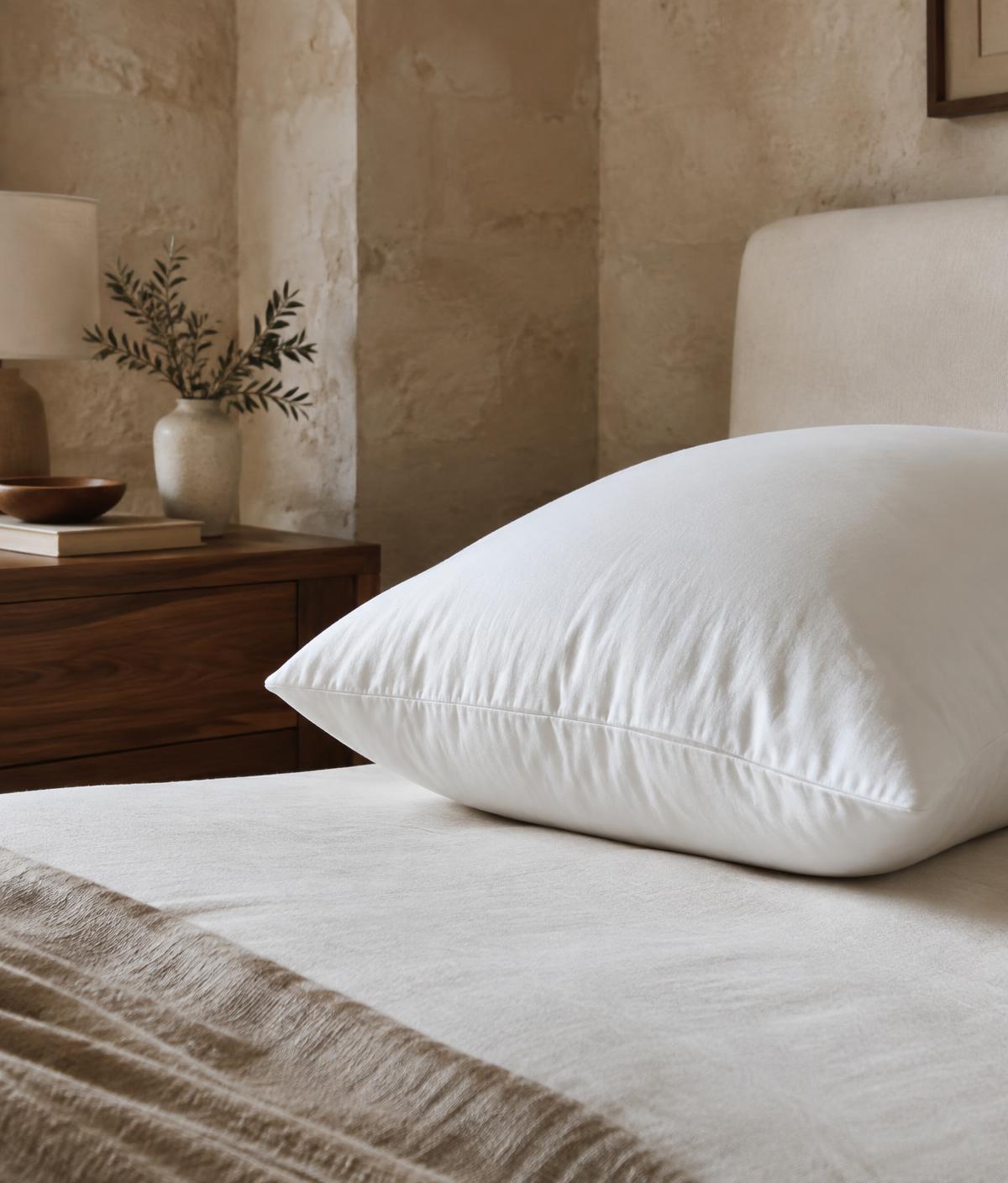
Pillows would be considerably easier to buy if everybody needed the same one. Shoulders, mattresses and sleeping positions have unfortunately declined to cooperate.
Pillow descriptions tend to reach for the same three words — low, medium and high. They are a reasonable starting point, but they don't tell you much about what will suit you. And despite the confidence of some shopping advice, there is no universally established ideal pillow height in centimetres. Researchers who study the subject have themselves noted the lack of evidence-based guidelines for choosing a pillow.
1. What pillow height actually means
The height printed on a specification is usually the pillow's uncompressed depth — how tall it stands on the bed with nothing resting on it. That isn't the height your head and neck experience.
What matters more is the effective height once your head is on it. Two pillows with the same listed depth can behave very differently: a soft fibre fill may compress a long way, while a denser foam will give less. Material, firmness and how much the pillow compresses all matter as much as the number on the label. There is no reliable formula that converts one into the other.
How much a pillow compresses depends partly on its filling and construction — we compare the main options in Memory Foam vs Wool vs Synthetic Pillows.
2. Why sleeping position changes the equation
Side sleepers: lying on your side, your shoulder normally creates a larger gap between the side of your head and the mattress. Research suggests individual body dimensions, including shoulder dimensions, matter when considering pillow height in this position — which is precisely why a single centimetre figure doesn't translate well from one person to the next.
Back sleepers: here the pillow needs to accommodate the head and neck without simply pushing the head further forward as the height increases. Experimental work has shown that changing pillow height changes the position of the neck, though it does not identify one measurement that suits every back sleeper.
Front sleepers: lying face down, the head is already turned to one side. A lot of pillow height can place the head and neck in a more pronounced position still. For that practical reason, some front sleepers prefer a very low pillow, or none under the head at all. That is a matter of comfort and preference rather than a clinical recommendation.
3. Your shoulders matter — especially on your side
A 2025 study looked specifically at side sleepers. Researchers examined four pillow heights alongside different neck-support conditions, and found that individual body dimensions influenced the relationship between pillow height and the position of the cervical spine.
It is worth being clear about its scale: this was a small study of nine healthy participants. It is useful evidence that pillow choice is individual. It is not evidence that you should buy a pillow of any particular height, and we have deliberately not turned its experimental measurements into shopping advice.
4. Your mattress matters too
The pillow is only half of the arrangement. On a softer mattress, your shoulder is likely to sink further in than it would on a firmer one, which changes the distance between your head and the sleeping surface.
It follows that pillow choice can't sensibly be made in complete isolation from the mattress beneath it. We are not aware of research establishing a precise formula linking mattress firmness to pillow height, so treat this as a matter of logic rather than a rule — and worth remembering if you change one without the other.
5. Higher isn't automatically more supportive
It is tempting to assume that a taller or fuller pillow means more support. The evidence doesn't back that up.
A 2016 biomechanics study of ten healthy adults found that changing pillow height altered the pressure beneath the head and neck and the predicted alignment of the cervical spine. In other words, height changes how the head and neck are positioned — and more height is simply different, not necessarily better.
Again, the study was small and conducted under experimental conditions. It does not establish an ideal consumer pillow height for everyone.
6. Why adjustable pillows make sense for some people
If you aren't sure what height you need, a pillow with removable filling or layers lets you experiment with its effective loft rather than committing immediately to a fixed height. Adding or removing a little fill over a few nights is a practical way to find out what feels right.
The Pillow Edit currently includes adjustable constructions such as the Simba Hybrid and the Woolroom Deluxe Washable Wool. That flexibility is useful for some sleepers; it doesn't make adjustable pillows inherently better than a well-chosen fixed one. We look at the trade-offs in Are adjustable pillows worth it?
7. A practical way to judge your pillow
Rather than chasing a measurement, it is more useful to think through a few practical questions:
- What is your usual sleeping position — and do you change position during the night?
- What are your shoulder and body proportions like?
- How deeply do you sink into your mattress?
- How does the pillow behave under load, with your head on it — not just how tall it measures on the bed?
- Does the height feel excessive or insufficient when you settle down?
- Is there a trial or return period, so you can find out over several nights rather than in a shop?
8. What if you have persistent neck pain?
Choosing a pillow for comfort is different from treating persistent neck pain or another musculoskeletal problem. No particular height, filling or product can be relied on to treat it.
If you have persistent or concerning symptoms, it is worth seeking appropriate healthcare advice — starting with your GP — rather than relying on a shopping guide.
Once you know the sort of height and construction you're looking for, the choice becomes considerably easier.
The Velquies view
The most useful number on a pillow specification isn't necessarily its height. What matters is the height it becomes beneath you. Sleeping position, shoulders, mattress and compression all have a vote — which is why we'd be wary of anybody prescribing one perfect measurement for everyone.
Key takeaways
- There is no universally established ideal pillow height.
- Effective height under your head matters more than the listed depth.
- Sleeping position, shoulder width and mattress all change what suits you.
- Higher is different, not automatically more supportive.
- Persistent neck pain is a matter for healthcare advice, not a new pillow.
Sources and references
- Tian S, Yao C, Wang Y, et al. The individualized optimal pillow height and neck support design for side sleepers. Medical & Biological Engineering & Computing. 2025;63(2):535–544.
- Ren S, Wong DW-C, Yang H, Zhou Y, Lin J, Zhang M. Effect of pillow height on the biomechanics of the head-neck complex: investigation of the cranio-cervical pressure and cervical spine alignment. PeerJ. 2016;4:e2397.
Some links on this page may earn Velquies a commission. This never determines what earns a place in The Edit. Read our affiliate disclosure.